




If You Disappeared for 30 Days, Would Your Business Survive?
I want you to imagine something uncomfortable.
You wake up tomorrow and decide you are gone for 30 days.
No email.
No Zoom calls.
No checking Slack.
No replying to DMs.
No “just one quick thing.”
You vanish.
Not because you are sick.
Not because you failed.
But because you chose to.
Would your business survive?
Most entrepreneurs hate this question.
Because deep down, they know the answer.
The Founder Dependency Trap
When most people start a business, they are the engine.
They sell.
They deliver.
They follow up.
They invoice.
They post content.
They manage clients.
In the beginning, that is normal.
But five years later?
If the business still collapses when you step away, you do not own a company.
You own a job with extra stress.
Inside Let Go Boss, this is the shift we obsess over.
We are not trying to help you earn income.
We are trying to help you remove yourself from being the bottleneck.

Why Most Businesses Cannot Survive Without the Founder
It is not because you are irreplaceable.
It is because your systems are undocumented.
Think about it:
Is your onboarding process written down?
Does your team know exactly how to respond to common client requests?
Are your offers clearly packaged and priced?
Do you have automated follow-ups?
Does your CRM track everything in one place?
Or is everything living in your head?
If the business exists inside your brain, it dies when you unplug.
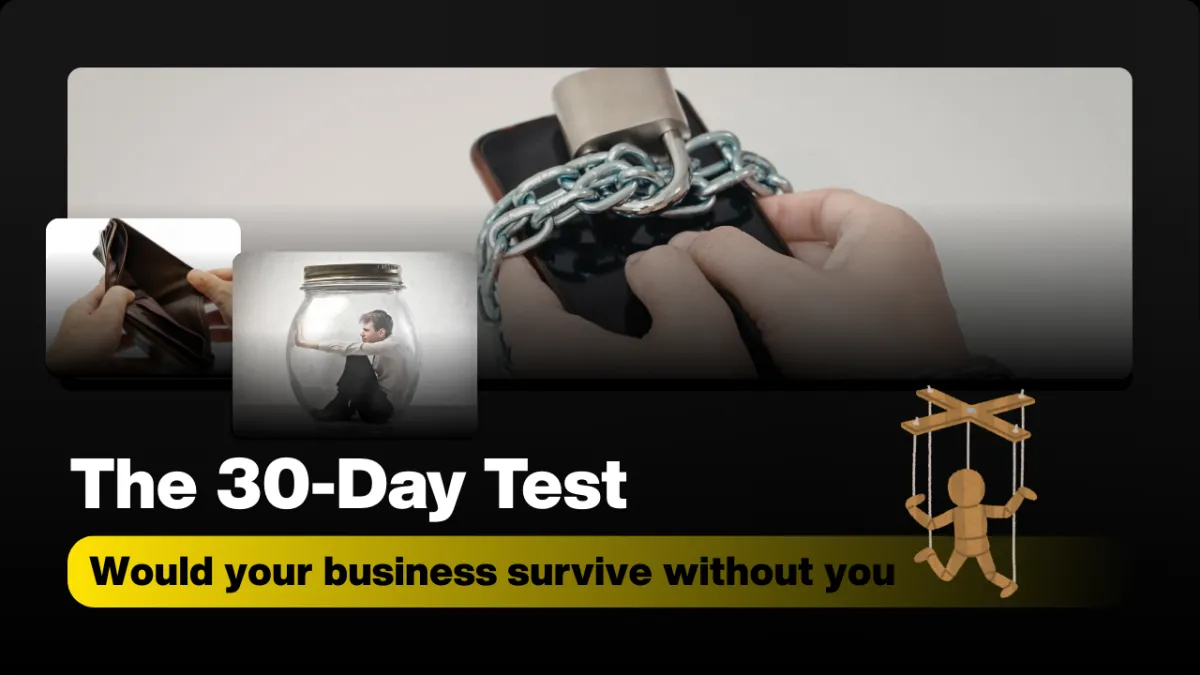
The 30-Day Test
In our coaching sessions, I sometimes ask members to design their “30-day exit.”
Not permanently.
Temporarily.
We map it out:
Who handles new leads?
Who runs operations?
What automations cover follow-ups?
What scripts replace your explanations?
What dashboards track performance?
At first, it feels overwhelming.
Then something powerful happens.
Clarity.
You realize most of what you do daily should not require you.
Automation Is About Insurance
People think automation is about efficiency.
It is not.
It is about resilience.
When you automate:
Appointment confirmations
Payment reminders
Onboarding sequences
Client updates
Internal task assignments
You are building insurance against your own absence.
AI is not there to make you fancy.
It is there to protect your business from fragility.
The Emotional Side of Letting Go
Here is the truth most founders will not admit.
Sometimes we do not build systems because we like being needed.
It feels powerful.
It feels validating.
But that validation is expensive.
If your business cannot breathe without you, you will never truly relax.
Freedom is not making money.
Freedom is knowing revenue continues when you step back.
The Difference Between Growth and Control
Growth requires surrender.
Control requires micromanagement.
You cannot scale and control every detail forever.
At some point, you must:
Standardize processes
Train others
Trust systems
Let automation handle repetition
Inside Let Go Boss, we do not just talk about scaling revenue.
We talk about scaling independence.
Because if you double revenue but double your stress, you did not win.

Designing a Business That Outlives You
Imagine this version of your business:
Leads come in automatically.
They receive structured follow-up.
They book on your calendar without friction.
Your team handles delivery through defined workflows.
Reviews are requested automatically.
Reports are generated automatically.
You step away for 30 days.
Revenue does not disappear.
That is the goal.
Not hustle.
Not burnout.
Not heroic effort.
Structure.
So Ask Yourself Again
If you disappeared for 30 days, would your business survive?
If the answer is no, that is not failure.
It is a design issue.
And design can be fixed.
Every week inside Let Go Boss, we walk through how to build businesses that are structured, automated, and scalable.
Not so you can disappear.
But so you finally have the option.
If you are ready to build something that does not depend on your constant presence, join our free weekly coaching calls at:
letgoboss.com
Build it right.
Systemize it properly.
LET GO BOSS.